
IRD Services & Registration
Tax Clearance Certificate Nepal: Complete IRD Application Guide
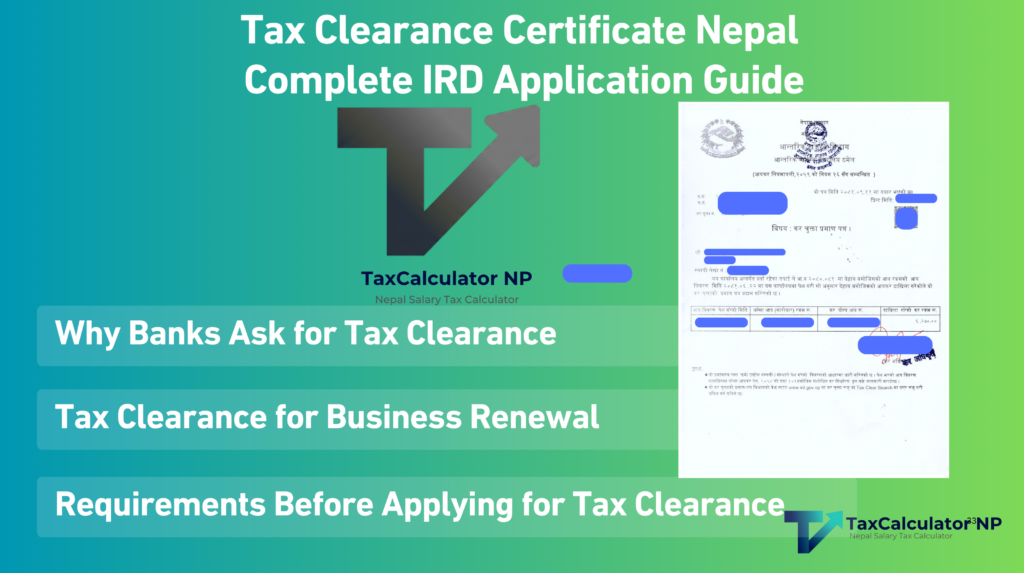
A tax clearance certificate confirms that a taxpayer has submitted the required tax returns and paid the tax shown as payable up to a specified date or fiscal year. In Nepal, the Inland Revenue Department issues this document to eligible individuals, employees, firms and companies.
Banks may request a tax clearance certificate Nepal document while assessing business income, professional earnings or a large loan proposal. It may also be required for business-license renewal, public tenders, regulatory approvals and certain overseas documentation.
Getting the certificate does not begin with the certificate application itself. You must first file the correct income tax return, pay outstanding tax and make sure the return has been verified in the IRD system.
Last operational review: August 2026
What Is a Tax Clearance Certificate?
A tax clearance certificate, commonly called Kar Chukta Praman Patra, is an official confirmation that a taxpayer has submitted the required income or financial statements and paid the tax declared as payable.
According to the Inland Revenue Department’s tax-clearance guidance, the certificate is issued at the taxpayer’s request after the required returns and taxes have been submitted.
The certificate normally identifies:
- Taxpayer’s registered name
- Permanent Account Number or PAN
- Fiscal year
- Tax office
- Tax-clearance certificate number
- Issue date
- Tax-clearance status
- QR code or verification information, where available
A certificate relates to a particular fiscal year or date. It is not a permanent confirmation that the taxpayer will never have another tax liability.
If the IRD later finds undeclared income during an audit, investigation or reassessment, the taxpayer can still be required to pay additional tax. Holding a certificate does not prevent the department from reviewing the return later.
Is Tax Clearance Mandatory for Everyone?
No. The IRD states that obtaining the certificate is not compulsory for every taxpayer in every situation.
You normally request it when another organization requires proof of tax compliance.
A certificate may be requested for:
- Business-loan applications
- Working-capital and overdraft facilities
- Public procurement and tender participation
- Business or professional licence renewal
- Company or business closure
- Regulatory approvals
- Government contracts
- Foreign investment or profit-repatriation procedures
- Certain visa, employment or overseas documentation
- Proof of declared income
The certificate itself is issued without a separate IRD certificate fee. However, a physical application may require a Rs.10 revenue stamp on the application, according to the IRD document checklist.
Why Banks Ask for Tax Clearance
From a banking perspective, a tax-clearance document helps the credit team confirm that income declared for a loan is supported by tax records.
For a business borrower, the bank may compare:
- Tax clearance certificate
- Audited financial statements
- Income tax return
- VAT returns
- Bank account turnover
- Sales and purchase records
- Existing loan statements
- Credit Information Bureau report
- Business registration documents
- Projected cash flow
A certificate showing no outstanding declared tax is useful, but it does not prove that the business can repay a loan. The bank still evaluates cash flow, existing debt, collateral, business stability and credit history.
Tax Clearance for Salaried Borrowers
A salaried borrower may not always need an IRD-issued certificate for a small personal or salary loan.
Banks commonly begin with:
- Salary certificate
- Recent payslips
- Appointment or employment letter
- Bank statement
- PAN
- Employer-issued annual tax certificate
- Employer’s e-TDS record
An IRD tax clearance may be requested when the loan is large, the applicant has income from multiple sources, or the reported income needs further verification.
If the tax deducted from your salary has not been deposited and verified against your PAN, obtaining the certificate can be delayed. Always compare the PAN on your payslip and tax certificate with your actual Personal PAN.
Tax Clearance for Business Loans
For business loans, working-capital facilities and overdrafts, banks are more likely to request the latest certificate.
The income stated in the loan application should match the tax return and financial statements. A business should not show low income to the IRD and much higher income to the bank without a clear and supportable explanation.
Such a mismatch can lead to:
- Additional questions from the credit team
- Rejection of projected income
- Lower loan eligibility
- Request for revised financial statements
- Compliance escalation
- Delay in loan approval
Submit the latest available fiscal-year certificate unless the bank asks for a specific period.
Tax Clearance for Business Renewal and Going Abroad
Municipalities, regulators, government agencies and licensing bodies may request tax clearance before renewing a business or professional licence.
The exact requirement depends on the registering authority and type of business. Confirm the document checklist before visiting the licensing office.
Is Tax Clearance Required to Travel Abroad?
A tax-clearance document is not a universal airport departure requirement for every Nepali citizen.
However, it may be requested as part of:
- Visa documentation
- Proof of self-employment income
- Foreign employment or contract documentation
- Foreign study financial documentation
- Business-related foreign exchange processing
- Profit or investment repatriation
- Government approval for certain foreign payments
- Overseas tender or professional registration
Check the embassy, bank, employer or government agency’s exact checklist. Do not apply only because someone informally says that every traveller needs it.
Requirements Before Applying for Tax Clearance
Before requesting the certificate, check the taxpayer’s complete IRD record.
You should confirm that:
- PAN registration is active.
- The correct income tax return has been filed.
- The return has been submitted and verified.
- The calculated tax has been paid.
- Previous fiscal-year returns are not missing.
- Old income tax arrears are cleared.
- VAT returns are filed, if registered for VAT.
- VAT payments are up to date.
- e-TDS statements are submitted and verified.
- Tax deducted in your name appears under the correct PAN.
- Financial statements match the tax return.
- Payment vouchers are correctly posted.
Submitting a return online does not always mean that the return has been verified. The portal may generate a submission number even when office or self-verification is still pending.
A return that remains unverified can delay the certificate.
Which Income Tax Return Should You File?
The IRD portal provides D-01, D-02 and D-03 income tax return forms. The correct form depends on taxpayer type, turnover, taxable income, income source and other statutory conditions.
Do not select a return using turnover alone.
The following summary reflects the IRD’s 2083/84 guidance for natural persons.
| Return | General taxpayer category | Main financial limits |
|---|---|---|
| D-01 | Qualifying resident natural person under presumptive tax | Annual turnover up to Rs.30 lakh and taxable business income up to Rs.3 lakh |
| D-02 | Qualifying resident natural person under turnover tax | Annual turnover above Rs.30 lakh and up to Rs.1 crore, with taxable business income up to Rs.10 lakh |
| D-03 | Regular self-assessment taxpayer | Taxpayers who do not qualify for D-01 or D-02 |
These are eligibility summaries, not the only conditions.
D-01 Return: Presumptive Taxpayer
D-01 is designed for a qualifying small business operated by a resident natural person.
The taxpayer generally must have:
- Annual business turnover not exceeding Rs.30 lakh
- Taxable business income not exceeding Rs.3 lakh
- Resident natural-person status
- Eligibility under the presumptive-tax provisions
- No disqualifying VAT or business condition
The tax is normally a fixed amount based on the location of the business:
- Metropolitan or sub-metropolitan area: Rs.7,500
- Municipal area: Rs.4,000
- Other area: Rs.2,500
These were the amounts published by the IRD for fiscal year 2083/84. Check the selected fiscal year before filing because the amounts can change.
A private limited company cannot use D-01 merely because its turnover is below Rs.30 lakh. D-01 applies to qualifying natural persons, not every small taxpayer.
D-02 Return: Turnover Taxpayer
D-02 is for a qualifying resident natural person whose business turnover is above the D-01 limit but within the turnover-tax ceiling.
Under the IRD’s 2083/84 guidance, the person generally must have:
- Income only from a Nepal-source business
- Annual business turnover above Rs.30 lakh and up to Rs.1 crore
- Taxable business income up to Rs.10 lakh
- Resident natural-person status
- Eligibility under the turnover-tax provisions
Doctors, engineers and similar professionals providing consultancy or specialist services are excluded from this simplified turnover-tax treatment.
Therefore, a doctor with Rs.40 lakh of professional turnover should not automatically choose D-02 just because the turnover is between Rs.30 lakh and Rs.1 crore.
D-03 Return: Regular Income Tax Return
D-03 is the regular self-assessment return. It generally applies when the taxpayer does not qualify for D-01 or D-02.
Common D-03 taxpayers include:
- Private and public companies
- Partnerships and other entities
- Businesses with turnover above Rs.1 crore
- Taxpayers with taxable business income above the simplified limits
- Professional and specialist service providers excluded from D-02
- Taxpayers with more complex income sources
- Taxpayers required to submit full financial statements
- Natural persons who do not satisfy D-01 or D-02 conditions
A company with only Rs.20 lakh turnover may still need D-03 because D-01 and D-02 are intended for qualifying resident natural persons.
D-03 may require detailed schedules, financial statements and supporting information. Where an audit is required, the relevant audited report must also be uploaded and submitted.
What About Employees?
An employee with only one employer may not need to file D-01, D-02 or D-03 merely to obtain salary tax clearance.
The employer deducts salary tax and reports it through e-TDS under the employee’s PAN.
The IRD FAQ states that a resident person with only salary income below the applicable filing threshold, one employer at a time and no specified additional claim may not have to file a separate income tax return. The current filing requirement must still be checked if the employee:
- Earns salary above the applicable threshold
- Has more than one employer
- Has business, investment or other taxable income
- Claims deductions requiring a return
- Has foreign income
- Has an unresolved final tax liability
The IRD also provides a process for eligible single-employer taxpayers to obtain a QR-coded online certificate.
How to Apply for Tax Clearance Through the IRD Tax Portal
Use only the official IRD Taxpayer Portal. Do not enter your PAN, password or tax information on an unofficial website.
The portal can sometimes be slow. Prepare your documents before starting and save the submission number after it is generated.
Step 1: Confirm Your PAN and Tax Office
Check that your PAN is active and that your name matches your citizenship or business registration.
Also confirm which Inland Revenue Office or Taxpayer Service Office controls your PAN. Going to the physically closest office does not guarantee that it can complete your verification.
Step 2: Select the Correct Fiscal Year
Choose the fiscal year for which you need tax clearance.
An income tax return is normally filed after the relevant income year has ended. Do not accidentally select the current year when you are filing the previous completed year.
Step 3: Open the Income Tax Section
From the taxpayer portal:
- Open Income Tax.
- Select D-01 Return Entry, D-02 Return Entry or D-03 Return Entry.
- Choose the form that matches your taxpayer category.
If you are uncertain, confirm the form with your accountant or assigned tax office before submission.
Step 4: Generate a Submission Number
Enter the information requested by the portal, which may include:
- Username
- Password
- PAN
- Fiscal year
- Mobile number
- Contact information
Select Register to generate a submission number.
Save this number. You need it to reopen, complete, print or verify the return.
Step 5: Complete the Return
For D-01, enter the business location, turnover and presumptive-tax details.
For D-02, enter the turnover by applicable business category and calculate the turnover tax.
For D-03, complete the relevant income, expense, asset, liability and tax schedules. Upload financial statements and audit documents where required.
Check that:
- Turnover matches business records.
- TDS credits use valid transaction details.
- Advance tax payments are included.
- VAT turnover is reasonably consistent with income tax turnover.
- Tax payment vouchers contain the correct PAN and revenue heading.
- Opening and closing figures match the financial statements.
Step 6: Save, Review and Submit
Use the save function while completing the return.
After reviewing every section, select Submit. Once final submission is complete, the edit function may be disabled and the print option enabled.
Do not submit an incomplete return simply to obtain a submission number.
Step 7: Pay the Outstanding Tax
Pay the tax calculated by the return through an approved method.
Depending on the portal and payment facility, this may include:
- Electronic payment
- connectIPS
- Bank counter payment
- Government revenue voucher
Confirm that the payment contains the correct:
- PAN
- Fiscal year
- Revenue heading
- Tax amount
- Voucher or transaction number
A payment made under the wrong PAN or fiscal year may not clear the liability automatically.
Step 8: Verify the Return
A submitted return may still need verification.
The IRD allows verification through:
- The assigned Inland Revenue Office
- A Taxpayer Service Office
- The Medium Taxpayer Office
- The Large Taxpayer Office
- Authorized self-verification, where available
If you have self-verification access, log in through General Login → Taxpayer Login, open the income-tax module and select the relevant submission number.
A return is not treated as properly filed until the required verification is complete.
Step 9: Clear Other Outstanding Returns
Before requesting the certificate, check for:
- Previous income tax returns
- Advance tax instalments
- Monthly or quarterly VAT returns
- e-TDS submissions
- Excise returns, where applicable
- Old tax assessments
- Interest and penalties
- Unmatched payment vouchers
Even a small system balance can stop automatic issuance.
Step 10: Generate or Request the Certificate
The final method depends on the taxpayer category and system status.
For eligible D-01 taxpayers, the IRD states that the taxpayer can generate the certificate through the computer system after filing the D-01 return and paying the presumptive tax. A separate office application may not be required.
D-02 and D-03 taxpayers may need final review or approval from the assigned tax office, especially when financial statements, TDS credits or previous balances require verification.
Eligible single-employer employees can use the IRD’s QR-coded online tax-clearance process when their salary and e-TDS records meet the system requirements.
Download the certificate and check:
- Name
- PAN
- Fiscal year
- Certificate number
- Issue date
- QR code
- Tax office
Report an error before submitting the document to a bank or government agency.
How Long Does it Take to Get the Certificate?
The processing time depends heavily on your taxpayer category. For eligible D-01 taxpayers and single-employer salaried workers using the automated IRD system, the certificate is often generated instantly as a downloadable PDF. For D-02 and D-03 taxpayers, or cases where e-TDS data mismatches occur, manual verification by a tax officer is required. This office verification can take anywhere from a few hours to a few working days, assuming all your documents and payment vouchers are in order.
Visiting the Tax Office or Inland Revenue Office
If online issuance is unavailable, visit the office controlling your PAN.
Searching tax office near me may show the closest Inland Revenue Office, but the closest building may not be the office assigned to your PAN.
Use the official IRD office contact directory to check the address, phone number and email. Call before visiting if your return involves an old fiscal year, unmatched payment or a transferred business.
Documents to Carry for Final Verification
Carry originals where available and at least one clear photocopy set.
| Document | Employee | D-01 or D-02 taxpayer | D-03 taxpayer |
|---|---|---|---|
| PAN certificate | Yes | Yes | Yes |
| Citizenship or representative ID | Yes | Yes | Yes |
| Application with Rs.10 revenue stamp, if requested | Yes | Yes | Yes |
| Income tax return submission print | If applicable | Yes | Yes |
| Tax payment voucher | If applicable | Yes | Yes |
| Previous tax-clearance certificate | Helpful | Helpful | Helpful |
| Employer salary and tax certificate | Yes | No | If salary is included |
| Verified e-TDS details | Yes | If applicable | If applicable |
| Turnover or sales summary | No | Yes | Yes |
| Financial statements | No | If requested | Yes |
| Audit report | No | Usually no | Where applicable |
| VAT return summary | No | If VAT registered | If VAT registered |
| Business registration certificate | No | Yes | Yes |
| Authorization letter | If represented | If represented | If represented |
The IRD’s official checklist specifically mentions:
- Written application with a Rs.10 revenue stamp
- Filed income tax return
- Payment of the assessed tax
- No outstanding returns or tax from earlier years
- Financial statements and tax-payment voucher where required
- Employer-certified income and tax-deposit details for employees
- Additional documents requested by the office
Practical Office-Visit Checklist
Before reaching the counter:
- Arrange documents by fiscal year.
- Keep the PAN visible on every relevant copy.
- Write the submission and voucher numbers on a separate page.
- Carry the mobile number linked to the portal.
- Take the accountant or authorized representative if the return is complex.
- Carry an authorization letter if the taxpayer will not attend.
- Ask which section handles tax clearance before waiting in a general queue.
- Request a written deficiency list if the certificate cannot be issued.
Do not hand over your taxpayer-portal password to an unauthorized person. If an accountant needs system access, use a controlled process and change the password afterward.
How to Verify a Tax Clearance Certificate
Banks, government offices and other institutions can verify a certificate through the official IRD Tax Clearance Search.
The search may require:
- PAN
- Fiscal year
- Tax-clearance certificate number
A valid QR code may also direct the user to the official verification record.
A PDF or photocopy without a matching IRD record may not be accepted.
Common Reasons Tax Clearance Is Delayed
The Return Was Submitted but Not Verified
A submission number does not always mean the filing is complete.
Check the return status and complete office or self-verification.
Employer e-TDS Is Missing
If your employer deducted salary tax but did not submit or verify e-TDS, the tax may not appear under your PAN.
Contact the employer’s payroll or finance department. Ask for the e-TDS transaction details and correction if the wrong PAN was used.
Tax Was Paid Under the Wrong PAN
A typing error in the PAN can place the payment under another record or in an unmatched status.
Take the original voucher and payment evidence to the assigned office.
Previous Returns Are Missing
The office may refuse current-year clearance when an earlier required return has not been filed.
Complete the missing returns and pay applicable tax, interest or penalties.
VAT and Income Tax Turnover Do Not Match
A large unexplained difference between VAT sales and income tax turnover can lead to additional review.
Prepare a reconciliation showing exempt sales, non-business receipts, credit notes and timing differences.
Financial Statements Do Not Match the Return
For D-03 taxpayers, profit, turnover, assets and tax figures should agree with the submitted financial statements.
Correct genuine errors through the process directed by the IRD. Do not alter one document merely to make it match another.
Frequently Asked Questions
How much does a tax clearance certificate cost in Nepal?
The IRD does not charge a separate certificate-issuance fee. However, a physical application may require a Rs.10 revenue stamp. All outstanding tax, interest and penalties must be paid before issuance.
Can I get tax clearance online?
Yes, online issuance is available for eligible taxpayers. D-01 taxpayers and qualifying single-employer employees may be able to generate the document electronically. D-02 and D-03 cases may require office verification depending on the taxpayer’s records.
How long is a tax clearance certificate valid?
The certificate confirms tax status for the fiscal year or date stated on it. It is not a lifetime certificate. A bank, embassy or licensing authority may ask for the latest completed fiscal year.
Can I get tax clearance without filing an income tax return?
A salaried person who is not required to file a separate return may obtain clearance based on employer income and verified e-TDS records. A business taxpayer required to file D-01, D-02 or D-03 must complete the applicable return first.
Can I visit any tax office?
The office assigned to your PAN normally handles verification and issuance. If you search tax office near me, use the result only as a location guide. Confirm jurisdiction through the IRD directory before travelling.
Does tax clearance guarantee loan approval?
No. It supports income and compliance verification, but the bank still reviews repayment capacity, credit history, security and existing liabilities.
Does the certificate stop a future tax audit?
No. The IRD can reassess tax if an audit or investigation identifies additional income or an incorrect claim.
What should I do if the certificate contains an error?
Contact the issuing office immediately. Carry the PAN, return, payment proof and incorrect certificate. Do not edit the PDF yourself.
Final Tax-Clearance Checklist
Before submitting the certificate to a bank, embassy or licensing authority, confirm that:
- The registered name is correct.
- The PAN is correct.
- The required fiscal year is shown.
- All returns are verified.
- All declared tax is paid.
- Employer e-TDS is correctly posted.
- The certificate number is readable.
- The QR code works.
- The certificate can be found in the IRD verification system.
- The receiving organization accepts that fiscal year.
A tax clearance certificate should be the final result of clean tax records, not the first step. File the correct return, clear every outstanding liability and verify the details before applying.
For salary-related planning, use the calculator on taxcalculatornp.com to estimate annual tax and compare it with the amount deducted by your employer. The calculator provides an estimate; the Inland Revenue Department makes the final assessment.
Official References
- IRD Taxpayer Portal
- IRD Tax Clearance Guidance and FAQs
- IRD 2083/84 Rates for Natural Persons
- IRD Tax Clearance Verification
- IRD Office Contact Directory
- IRD Online Tax Clearance Process for Single-Employer Taxpayers
Disclaimer: This guide provides general tax information. Return eligibility, required documents and portal procedures can change. Confirm complex cases with the assigned Inland Revenue Office or a qualified tax professional.